
- Популярные видео
- Авто
- Видео-блоги
- ДТП, аварии
- Для маленьких
- Еда, напитки
- Животные
- Закон и право
- Знаменитости
- Игры
- Искусство
- Комедии
- Красота, мода
- Кулинария, рецепты
- Люди
- Мото
- Музыка
- Мультфильмы
- Наука, технологии
- Новости
- Образование
- Политика
- Праздники
- Приколы
- Природа
- Происшествия
- Путешествия
- Развлечения
- Ржач
- Семья
- Сериалы
- Спорт
- Стиль жизни
- ТВ передачи
- Танцы
- Технологии
- Товары
- Ужасы
- Фильмы
- Шоу-бизнес
- Юмор
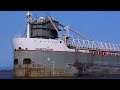
Arthur M. Anderson - Hauling a Real Mess! (See Description)
Here is the steamship Arthur M. Anderson arriving in Duluth, Minnesota on the morning of June 21, 2023. For this visit, she was arriving empty and was scheduled to load blast furnace trim at the Hallett 5 dock in West Duluth. On her way in, the Anderson traded master salutes (three long and two short blasts) with the Aerial Lift Bridge.
Blast furnance trim is basically just crushed taconite (iron ore), utilized in steel production. Loading of blast furnace trim is often a longer (and messier) process than loading taconite pellets, as the crushed taconite is loaded from ground-based front-end loaders which dump the cargo into a conveyor that lifts the material from the dock to the ship. A lot of dust is generated in the process and you'll often see the ships with ore dust caked on the side after loading is complete. I have to imagine it's not the favorite cargo for crews to haul!
This arrival was captured on the first official day of summer, so that was something for the crew to celebrate. The summer months are usually the calmest for boat travel on the Great Lakes. The storms we often see in the spring and autumn months are mostly absent in the summer. While rain and thunderstorms occur on the lakes, we rarely see the gales and high waves in the summer which bring shipping to a halt. After a particularly stormy spring this year, the lake boat crews are likely enjoying this respite during the summer season.
The 767-foot Arthur M. Anderson was launched in 1952, being one of eight AAA-class lakers built around this time... a designation applied to a series of lakers which (at the time) were leaps forward in cargo carrying size and capacity. Her fleet mates the Philip R. Clarke and Cason J. Callaway were also built as AAA-class lakers around the same time. The Anderson is powered by a steam turbine producing 7,700 shp. In the spring of 1975. she was lengthened by 120 feet and was converted to a self-unloader during winter layup in 1981-1982. She can carry up to 25,300 tons of cargo.
The Arthur M. Anderson is most well known for being the last ship to have visual contact, radar contact, and radio contact with the Edmund Fitzgerald on the night of November 10, 1975. She was following the Fitzgerald at the time of her sinking, having lost visual contact during a snow squall. After reaching the safety of Whitefish Bay, it became clear to the Anderson's crew that the Fitzgerald had likely gone to the bottom during the storm. The Anderson's crew, led by Captain Bernie Cooper, turned around and headed back into storm to search for survivors... as no Coast Guard vessels were nearby to help search. She was joined a short while by the William Clay Ford, another AAA-class laker that had also left the safety of Whitefish Bay to assist in the search. While they found no survivors, the heroic actions of these two crews is still fondly remembered today by boat watchers and history enthusiasts. The William Clay Ford was scrapped in 1986, but the Anderson continues to sail on and remains a living legend on the Great Lakes. May she continue to sail safely for many years to come!
Видео Arthur M. Anderson - Hauling a Real Mess! (See Description) канала 1 Long 2 Short
Blast furnance trim is basically just crushed taconite (iron ore), utilized in steel production. Loading of blast furnace trim is often a longer (and messier) process than loading taconite pellets, as the crushed taconite is loaded from ground-based front-end loaders which dump the cargo into a conveyor that lifts the material from the dock to the ship. A lot of dust is generated in the process and you'll often see the ships with ore dust caked on the side after loading is complete. I have to imagine it's not the favorite cargo for crews to haul!
This arrival was captured on the first official day of summer, so that was something for the crew to celebrate. The summer months are usually the calmest for boat travel on the Great Lakes. The storms we often see in the spring and autumn months are mostly absent in the summer. While rain and thunderstorms occur on the lakes, we rarely see the gales and high waves in the summer which bring shipping to a halt. After a particularly stormy spring this year, the lake boat crews are likely enjoying this respite during the summer season.
The 767-foot Arthur M. Anderson was launched in 1952, being one of eight AAA-class lakers built around this time... a designation applied to a series of lakers which (at the time) were leaps forward in cargo carrying size and capacity. Her fleet mates the Philip R. Clarke and Cason J. Callaway were also built as AAA-class lakers around the same time. The Anderson is powered by a steam turbine producing 7,700 shp. In the spring of 1975. she was lengthened by 120 feet and was converted to a self-unloader during winter layup in 1981-1982. She can carry up to 25,300 tons of cargo.
The Arthur M. Anderson is most well known for being the last ship to have visual contact, radar contact, and radio contact with the Edmund Fitzgerald on the night of November 10, 1975. She was following the Fitzgerald at the time of her sinking, having lost visual contact during a snow squall. After reaching the safety of Whitefish Bay, it became clear to the Anderson's crew that the Fitzgerald had likely gone to the bottom during the storm. The Anderson's crew, led by Captain Bernie Cooper, turned around and headed back into storm to search for survivors... as no Coast Guard vessels were nearby to help search. She was joined a short while by the William Clay Ford, another AAA-class laker that had also left the safety of Whitefish Bay to assist in the search. While they found no survivors, the heroic actions of these two crews is still fondly remembered today by boat watchers and history enthusiasts. The William Clay Ford was scrapped in 1986, but the Anderson continues to sail on and remains a living legend on the Great Lakes. May she continue to sail safely for many years to come!
Видео Arthur M. Anderson - Hauling a Real Mess! (See Description) канала 1 Long 2 Short
Duluth Minnesota Superior Wisconsin Canal Park Aerial Lift Bridge Lighthouse Ships Shipping Laker Freighter Ore Carrier Bulk Carrier Boat Great Lakes Lake Superior Edmund Fitzgerald Iron Ore Taconite Coal Transportation Lake Carrier Ship ship horn ship salute webcam harbor cam Paul Scinocca alaricdogface Duluth Harbor Cam Arthur M. Anderson Arthur Anderson steamer steamship Great Lakes Fleet Bernie Cooper
Комментарии отсутствуют
Информация о видео
21 июля 2023 г. 23:00:21
00:04:35
Другие видео канала
 James R. Barker - One Last Monster Salute for the Summer
 American Century and Wren 1 - Delivering a Bonus Lighthouse Salute
 Wilfred Sykes - Sounding a Master Salute at Blue Twilight
 Alpena - Departure from Superior - September 2017
 American Century - Why Lake Boats Always Beat Trains (See Description)
 Houtmangracht - A Most Peculiar Salute! (Plus Tugboat and Rail Action)
 Burns Harbor - A Rare Visit to Duluth
 Paul R. Tregurtha - The Queen Rules the Night!
 Walter J. McCarthy Jr. - Howling for Duluth Under a Full Moon
 American Integrity - The Eyes of a Monster
 Hon. James L. Oberstar - Dodging the Shadows in Duluth
 American Spirit - Intimidating Sight in the Night
 Walter J. McCarthy Jr. - Warm Day Arrival
 Merwedegracht - Stunning Lighting Courtesy of Mother Nature
 Michipicoten - Extremely Grey Day Brightened With a Salute
 Kaye E. Barker - Still Looking Sharp at 70!
 American Mariner - Making a Big Noise in the Night
 Philip R. Clarke - Watch Some Lake Pirates Make Noise and Throw Rocks
 Viking Octantis - One Final Visit for the Season
 Manitoulin - A Loud Return to Superior
