
- Популярные видео
- Авто
- Видео-блоги
- ДТП, аварии
- Для маленьких
- Еда, напитки
- Животные
- Закон и право
- Знаменитости
- Игры
- Искусство
- Комедии
- Красота, мода
- Кулинария, рецепты
- Люди
- Мото
- Музыка
- Мультфильмы
- Наука, технологии
- Новости
- Образование
- Политика
- Праздники
- Приколы
- Природа
- Происшествия
- Путешествия
- Развлечения
- Ржач
- Семья
- Сериалы
- Спорт
- Стиль жизни
- ТВ передачи
- Танцы
- Технологии
- Товары
- Ужасы
- Фильмы
- Шоу-бизнес
- Юмор
Chapter 1 : Chemical reactions and equations class 10 | Lecture 1 | Detailed Explanation
Chapter 1 : Chemical reactions and equations class 10 | Lecture 1 | Detailed Explanation
Video Description
Welcome to the first lecture of Class 10 Science Chapter 1 Chemical Reactions and Equations. In this video we explore the fundamental concepts of chemical changes and how to identify when a chemical reaction has occurred through practical NCERT activities.Topics CoveredWhat is a Chemical Change
We start by looking at daily life situations where the nature and identity of the initial substance change. Examples include:
Milk left at room temperature during summers
Iron articles left in humid atmospheres
Digestion of food in our body
The process of respiration
Activity 1.1 Burning of Magnesium Ribbon
Detailed explanation of why we clean the magnesium ribbon with sandpaper before burning.
Observation: Magnesium ribbon burns with a dazzling white flame and changes into a white powder called magnesium oxide.
Question: Why is this considered a chemical reaction?
Activity 1.2 Reaction of Lead Nitrate and Potassium Iodide
Mixing lead nitrate solution with potassium iodide solution.
Observation: What changes do we see in the test tube?.Activity 1.3 Reaction of Zinc with Dilute Acid
Action of dilute sulphuric acid or hydrochloric acid on zinc granules.
Observations: Evolution of hydrogen gas and change in the temperature of the conical flask.Properties of a Chemical Reaction
Based on these activities we can determine if a chemical reaction has taken place by observing:
Change in state Change in colour Evolution of a gas Change in temperature Important NCERT Questions Solved
Why should a magnesium ribbon be cleaned before burning in air? How do we identify the evolution of gas and change in temperature in laboratory experiments? Watch NextLecture 2: Writing and Balancing Chemical EquationsSubscribe to Pie Factor for more detailed NCERT Science and Mathematics tutorials for classes 9 to 12.TagsClass 10 Science, Chapter 1, Chemical Reactions and Equations, NCERT Science, Chemical Change Examples, Activity 1.1 Class 10, Activity 1.2 Class 10, Activity 1.3 Class 10, Properties of Chemical Reaction, Magnesium Ribbon Experiment, Zinc Granules Experiment, Science Lecture 1, CBSE Class 10 Chemistry
Видео Chapter 1 : Chemical reactions and equations class 10 | Lecture 1 | Detailed Explanation канала Pie Factor
Video Description
Welcome to the first lecture of Class 10 Science Chapter 1 Chemical Reactions and Equations. In this video we explore the fundamental concepts of chemical changes and how to identify when a chemical reaction has occurred through practical NCERT activities.Topics CoveredWhat is a Chemical Change
We start by looking at daily life situations where the nature and identity of the initial substance change. Examples include:
Milk left at room temperature during summers
Iron articles left in humid atmospheres
Digestion of food in our body
The process of respiration
Activity 1.1 Burning of Magnesium Ribbon
Detailed explanation of why we clean the magnesium ribbon with sandpaper before burning.
Observation: Magnesium ribbon burns with a dazzling white flame and changes into a white powder called magnesium oxide.
Question: Why is this considered a chemical reaction?
Activity 1.2 Reaction of Lead Nitrate and Potassium Iodide
Mixing lead nitrate solution with potassium iodide solution.
Observation: What changes do we see in the test tube?.Activity 1.3 Reaction of Zinc with Dilute Acid
Action of dilute sulphuric acid or hydrochloric acid on zinc granules.
Observations: Evolution of hydrogen gas and change in the temperature of the conical flask.Properties of a Chemical Reaction
Based on these activities we can determine if a chemical reaction has taken place by observing:
Change in state Change in colour Evolution of a gas Change in temperature Important NCERT Questions Solved
Why should a magnesium ribbon be cleaned before burning in air? How do we identify the evolution of gas and change in temperature in laboratory experiments? Watch NextLecture 2: Writing and Balancing Chemical EquationsSubscribe to Pie Factor for more detailed NCERT Science and Mathematics tutorials for classes 9 to 12.TagsClass 10 Science, Chapter 1, Chemical Reactions and Equations, NCERT Science, Chemical Change Examples, Activity 1.1 Class 10, Activity 1.2 Class 10, Activity 1.3 Class 10, Properties of Chemical Reaction, Magnesium Ribbon Experiment, Zinc Granules Experiment, Science Lecture 1, CBSE Class 10 Chemistry
Видео Chapter 1 : Chemical reactions and equations class 10 | Lecture 1 | Detailed Explanation канала Pie Factor
chemical reactions and equations class 10 chemical reactions and equations class 10 detailed explanation chemical reactions and equations class 10 full explanation chapter 1 chemical reaction and equation class 10th ch 1 chemical reactions and equations class 10 one shot chemical change class 10 chemical reaction class 10 rapid revision chemical reactions and equations class 10 rapid revision chemical reactions and equations class 10 ncert ncert chemistry chapter 1 piefactor
Комментарии отсутствуют
Информация о видео
4 апреля 2026 г. 17:19:50
00:44:32
Другие видео канала
 Class 10 Maths Chapter 2 Polynomials Exercise 2.2 | Lecture 5 | #liveclass
 Activity 1.1 Class 10 Science | Magnesium Ribbon Burning Experiment | Activity Analysis |
 Class 10 Maths Exercise 1.2 Q2 | Prove 3 + 2 root 5 is Irrational | Real Numbers | NCERT
 Class 10 Maths Chapter 2 | Exercise 2.2 Solutions | Relationship between Zeroes and coefficients
 Class 10 Maths Chapter 2 Exercise 2.1 Solutions | Polynomials | Very Important Concept
 Exercise 1.1 q2 class 10 | Real Numbers | NCERT Exercise 1.1 q2 Solutions
 Prove that two distinct lines cannot have more than one point in common | Theorem 5.1 | Class 9th
 Chapter 3 Pair of Linear Equation in Two Variable | NCERT | Exercsie 3.1 Question 5 Complete Solved
 Exercise 1.1 q3 class 10 | Real Numbers | NCERT Exercise 1.1 q3 Solutions
 Class 10th Chapter 1 Real Numbers | Lecture 1 | CBSE |
 Prove that 1 by root 5 is irrational | Prove that 1/√5 is irrational
 NCERT Exercise 4.2 Quadratic Equation | Chapter 4 Exercise 4.2 Complete Solution | Important
 Activity 1.4 class 10 Science Chemistry | Exam Oriented | Calcium oxide and water reaction Class 10
 Class 10 Maths Chapter 2 Polynomials Exercise 2.2 | Lecture 4 |
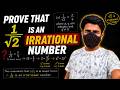 Prove that 1/√2 is irrational | Prove that 1/√2 is irrational Number | Class 10th
 Class 10 Maths Chapter 2 Polynomials Exercise 2.2 | Lecture 3 | #liveclass
 Polynomials: Types, Graphs & Zeroes | Class 10 Maths Chapter 2 Live | Lecture 1
 Activity 1.2 Class 10 Science | Potassium Iodide and Lead Nitrate reaction | Activity Analysis |
 Class 10 Maths | Chapter 1: Real Numbers | Exercise 1.2 Solutions
 Exercise 1.1 q6 class 10 | Real Numbers | NCERT Exercise 1.1 q6 Solutions
