
- Популярные видео
- Авто
- Видео-блоги
- ДТП, аварии
- Для маленьких
- Еда, напитки
- Животные
- Закон и право
- Знаменитости
- Игры
- Искусство
- Комедии
- Красота, мода
- Кулинария, рецепты
- Люди
- Мото
- Музыка
- Мультфильмы
- Наука, технологии
- Новости
- Образование
- Политика
- Праздники
- Приколы
- Природа
- Происшествия
- Путешествия
- Развлечения
- Ржач
- Семья
- Сериалы
- Спорт
- Стиль жизни
- ТВ передачи
- Танцы
- Технологии
- Товары
- Ужасы
- Фильмы
- Шоу-бизнес
- Юмор
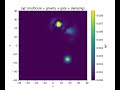
How Does the Universe's Cosmic Web Form? A Dark Matter Simulation
This video presents a computer simulation based on the Photonic Condensation Hypothesis (PCH), offering an alternative perspective on the nature of dark matter—one of the greatest mysteries of the universe. What you are witnessing is a visualization of how dark matter, behaving not as individual particles but as a colossal quantum wave, gives rise to the large-scale "cosmic web" structure of the universe.
▶ What Does This Simulation Represent?
This simulation visualizes the outcomes of a theoretical model called the Photonic Condensation Hypothesis (PCH). PCH proposes that dark matter is composed of ultra-light bosons, such as axions or dark photons. On galactic scales, these particles can exhibit behavior similar to a Bose-Einstein Condensate (BEC), forming a macroscopic quantum state.
The dynamics of the simulation are governed by the Schrödinger-Poisson equations, which couple quantum mechanics with gravity. You are watching initially dispersed clumps of matter coalesce under gravity over time, forming the filamentary and web-like structures that are characteristic of the cosmic web.
▶ Why is the PCH Model Significant?
The standard cosmological model (ΛCDM) predicts that dark matter density profiles in the centers of galaxies should be "cuspy," yet observations often point to a "cored" (flat) structure. This discrepancy is known as the "Cusp-Core Problem".
One of the major successes of the PCH model is that it naturally resolves this issue:
Quantum Pressure: The quantum pressure inherent in the model prevents matter from collapsing into an infinitely dense singularity, naturally forming a core.
Agreement with Observations: As a result, PCH successfully explains the observed cored density profiles in galaxy centers. Tests have shown that the PCH model provides a better fit than the standard NFW model for approximately 82% of the 168 galaxies analyzed from the SPARC dataset.
Wave Nature: According to PCH, dark matter behaves like a wave. This means that when two dark matter halos collide, they may not simply pass through each other like classical particles but could create interference patterns, much like water waves. This is one of the most distinctive predictions of the model, which can be tested with future observations.
This work builds a bridge between astrophysics and particle physics, presenting a potentially revolutionary paradigm for understanding the fundamental nature of dark matter.
For More Information on This Project:
https://doi.org/10.5281/zenodo.17119334
Prepared by: Sabahattin TÜRKOĞLU
Report Date: August 14, 2025
Keywords & Hashtags:
#DarkMatter #Cosmology #Astrophysics #Simulation #Science #Universe #PCH #PhotonicCondensation #BoseEinstein #QuantumPhysics #Galaxy #CosmicWeb #SchrodingerPoisson #TheoreticalPhysics
[END OF VIDEO DESCRIPTION]
Видео How Does the Universe's Cosmic Web Form? A Dark Matter Simulation канала sabahattin turkoğlu
▶ What Does This Simulation Represent?
This simulation visualizes the outcomes of a theoretical model called the Photonic Condensation Hypothesis (PCH). PCH proposes that dark matter is composed of ultra-light bosons, such as axions or dark photons. On galactic scales, these particles can exhibit behavior similar to a Bose-Einstein Condensate (BEC), forming a macroscopic quantum state.
The dynamics of the simulation are governed by the Schrödinger-Poisson equations, which couple quantum mechanics with gravity. You are watching initially dispersed clumps of matter coalesce under gravity over time, forming the filamentary and web-like structures that are characteristic of the cosmic web.
▶ Why is the PCH Model Significant?
The standard cosmological model (ΛCDM) predicts that dark matter density profiles in the centers of galaxies should be "cuspy," yet observations often point to a "cored" (flat) structure. This discrepancy is known as the "Cusp-Core Problem".
One of the major successes of the PCH model is that it naturally resolves this issue:
Quantum Pressure: The quantum pressure inherent in the model prevents matter from collapsing into an infinitely dense singularity, naturally forming a core.
Agreement with Observations: As a result, PCH successfully explains the observed cored density profiles in galaxy centers. Tests have shown that the PCH model provides a better fit than the standard NFW model for approximately 82% of the 168 galaxies analyzed from the SPARC dataset.
Wave Nature: According to PCH, dark matter behaves like a wave. This means that when two dark matter halos collide, they may not simply pass through each other like classical particles but could create interference patterns, much like water waves. This is one of the most distinctive predictions of the model, which can be tested with future observations.
This work builds a bridge between astrophysics and particle physics, presenting a potentially revolutionary paradigm for understanding the fundamental nature of dark matter.
For More Information on This Project:
https://doi.org/10.5281/zenodo.17119334
Prepared by: Sabahattin TÜRKOĞLU
Report Date: August 14, 2025
Keywords & Hashtags:
#DarkMatter #Cosmology #Astrophysics #Simulation #Science #Universe #PCH #PhotonicCondensation #BoseEinstein #QuantumPhysics #Galaxy #CosmicWeb #SchrodingerPoisson #TheoreticalPhysics
[END OF VIDEO DESCRIPTION]
Видео How Does the Universe's Cosmic Web Form? A Dark Matter Simulation канала sabahattin turkoğlu
Комментарии отсутствуют
Информация о видео
23 сентября 2025 г. 0:44:21
00:01:45
Другие видео канала
 YANKI — The Universe Waiting for You
 Yankı-Çöküş
 “Dark Energy Waves? Photonic Condensation Hypothesis (PCH) Simulation”
 Yankı-Türk Edebiyat Tarihinin En Kapsamlı Bilim Kurgu Evreni
 Yankı Romanı Eliasın Rüyası.
 How Does the Universe's Cosmic Web Form? A Dark Matter Simulation
 Yankı-Ufuktaki Işık
 Yankı-Çöküş
 Yankı-Çöküş Romanın dan Uyarlanmıştır.
 https://yanki-echo.netlify.app/
 Yankı-Uyanış -Türk Bilim Kurgu Romanı
 Sessizliğin İçinden Doğan Gelecek.2070'in külleri arasından yükselen bir bilinç
 Yankı Bilim Kurgu Roman Serisi Tanıtımı!
 Yankı-Uyanış Türk Bilim Kurgu Romanı
 Yankı-Çöküş Romanından Uyarlanmıştır.
 Gizlenemeyeceğini bilseydin, yine yapar mıydın? #bilimkurgu #distopya #yanki #sinema #kitapönerisi
