
- Популярные видео
- Авто
- Видео-блоги
- ДТП, аварии
- Для маленьких
- Еда, напитки
- Животные
- Закон и право
- Знаменитости
- Игры
- Искусство
- Комедии
- Красота, мода
- Кулинария, рецепты
- Люди
- Мото
- Музыка
- Мультфильмы
- Наука, технологии
- Новости
- Образование
- Политика
- Праздники
- Приколы
- Природа
- Происшествия
- Путешествия
- Развлечения
- Ржач
- Семья
- Сериалы
- Спорт
- Стиль жизни
- ТВ передачи
- Танцы
- Технологии
- Товары
- Ужасы
- Фильмы
- Шоу-бизнес
- Юмор
Energetics of Solution | Enthalpy of Solution Explained with Examples | Class 11 Chemistry Lecture
#Chemical_energetics #chemistry_class_11 #education #New_first_year_chemistry
Lec#67 -8 (Energetics of solution full explained)
Playlist with all Chemistry lectures for class 11 new book
https://www.youtube.com/playlist?list=PLg2RIdi_XZEJKcCZBVOsOLpmKlN1YOZvA
You can get the full chapter in a single PDF without a watermark here.
https://umairkhanacademy.com/get-fsc-chemistry-notes-pdf-by-sir-umair-khan/
Free Chemistry Notes for Chapter 6
https://umairkhanacademy.com/class-11-chemistry/
Energetics of Solution | Enthalpy of Solution Explained with Examples | Class 11 Chemistry Lecture
In this lecture, Sir Umair Khan explains the Energetics of Solution (ΔHsol) in detail with examples and easy-to-follow steps. This lecture is specially designed for Class 11 Chemistry (New Book) Chapter 6: Thermochemistry.
🔹 What you will learn in this lecture:
Definition of enthalpy of solution (ΔHsol)
Difference between exothermic and endothermic solution processes
Step-by-step explanation with examples
How solute-solute, solvent-solvent, and solute-solvent interactions affect ΔHsol
Energetics of dissolving ionic compounds in water
Important exam tips for board exams, MDCAT, and ECAT
👨🏫 About this lecture:
This video is part of the Class 11 Chemistry Chapter 6 series on Thermochemistry. Umair Khan Academy provides simple, exam-focused explanations to help students score high marks.
👉 Don’t forget to Like, Share & Subscribe for more Class 11 and 12 Chemistry lectures.
#11th_chemistry_new_book_2025 #chemicalenergetics #BondEnergy #highachieverschemistry #umairkhanacademy #1styearchemistry2025 #chemistry2025 #fscchemistry2025 #sirumairkhan
Related Searches:
standard conditions. Define standard enthalpy change of reaction, enthalpy change for stoichiometric amounts reacting completely. Define standard enthalpy change of combustion, burning one mole completely in excess oxygen. Define standard enthalpy change of formation, forming one mole of compound from elements. Define standard enthalpy change of atomization, forming one mole of gaseous atoms. Define standard enthalpy change of neutralization, forming one mole of water from acid and alkali. Define bond energy or bond dissociation energy, energy required to break one mole of a bond. Explain the relationship between bond breaking energy, absorbing energy (positive Delta H). Explain the relationship between bond formation energy, releasing energy (negative Delta H). Calculate enthalpy change of reaction, using average bond energies. Calculate the heat transferred, using the relationship q equals m c Delta T. How to measure enthalpy change of a reaction, using a glass calorimeter. Calculate enthalpy change, using the relationship negative m c Delta T over n moles. Define calorie content of food, energy released when food is consumed completely. Outline how enthalpy change relates, to the calorie content of food clearly. Explain Hess’s Law of Heat Summation, total enthalpy change is path independent. Apply Hess’s Law, to calculate enthalpy changes in multi-step reactions. Construct energy cycles or Hess cycles, illustrating enthalpy change routes visually. Calculate Enthalpy of Formation, using Enthalpy of Combustion data. Define dissolution, the process of dissolving a solute in a solvent readily. Define hydration, water molecules surrounding and interacting with solute ions. Define enthalpy of hydration, energy released during ion-dipole force formation. Explain the factors affecting hydration energy magnitude, charge and size of the ion (charge density). Define lattice energy, forming one mole ionic compound from gaseous ions. Explain the factors affecting lattice energy magnitude, charge and size of the ion clearly. Construct Born-Haber Cycles for ionic solids, calculating lattice energy using Hess’s Law. Perform calculations involving energy cycles, linking lattice energy and hydration energy. Define entropy, measure of energy distribution or system disorder. Explain entropy in terms of diffusion, and number of possible arrangements easily. Compare entropy values, based on number of particles, physical state, and hardness. Explain the sign of entropy changes, that occur during state change or gas molecule count change.
Видео Energetics of Solution | Enthalpy of Solution Explained with Examples | Class 11 Chemistry Lecture канала Umair Khan
Lec#67 -8 (Energetics of solution full explained)
Playlist with all Chemistry lectures for class 11 new book
https://www.youtube.com/playlist?list=PLg2RIdi_XZEJKcCZBVOsOLpmKlN1YOZvA
You can get the full chapter in a single PDF without a watermark here.
https://umairkhanacademy.com/get-fsc-chemistry-notes-pdf-by-sir-umair-khan/
Free Chemistry Notes for Chapter 6
https://umairkhanacademy.com/class-11-chemistry/
Energetics of Solution | Enthalpy of Solution Explained with Examples | Class 11 Chemistry Lecture
In this lecture, Sir Umair Khan explains the Energetics of Solution (ΔHsol) in detail with examples and easy-to-follow steps. This lecture is specially designed for Class 11 Chemistry (New Book) Chapter 6: Thermochemistry.
🔹 What you will learn in this lecture:
Definition of enthalpy of solution (ΔHsol)
Difference between exothermic and endothermic solution processes
Step-by-step explanation with examples
How solute-solute, solvent-solvent, and solute-solvent interactions affect ΔHsol
Energetics of dissolving ionic compounds in water
Important exam tips for board exams, MDCAT, and ECAT
👨🏫 About this lecture:
This video is part of the Class 11 Chemistry Chapter 6 series on Thermochemistry. Umair Khan Academy provides simple, exam-focused explanations to help students score high marks.
👉 Don’t forget to Like, Share & Subscribe for more Class 11 and 12 Chemistry lectures.
#11th_chemistry_new_book_2025 #chemicalenergetics #BondEnergy #highachieverschemistry #umairkhanacademy #1styearchemistry2025 #chemistry2025 #fscchemistry2025 #sirumairkhan
Related Searches:
standard conditions. Define standard enthalpy change of reaction, enthalpy change for stoichiometric amounts reacting completely. Define standard enthalpy change of combustion, burning one mole completely in excess oxygen. Define standard enthalpy change of formation, forming one mole of compound from elements. Define standard enthalpy change of atomization, forming one mole of gaseous atoms. Define standard enthalpy change of neutralization, forming one mole of water from acid and alkali. Define bond energy or bond dissociation energy, energy required to break one mole of a bond. Explain the relationship between bond breaking energy, absorbing energy (positive Delta H). Explain the relationship between bond formation energy, releasing energy (negative Delta H). Calculate enthalpy change of reaction, using average bond energies. Calculate the heat transferred, using the relationship q equals m c Delta T. How to measure enthalpy change of a reaction, using a glass calorimeter. Calculate enthalpy change, using the relationship negative m c Delta T over n moles. Define calorie content of food, energy released when food is consumed completely. Outline how enthalpy change relates, to the calorie content of food clearly. Explain Hess’s Law of Heat Summation, total enthalpy change is path independent. Apply Hess’s Law, to calculate enthalpy changes in multi-step reactions. Construct energy cycles or Hess cycles, illustrating enthalpy change routes visually. Calculate Enthalpy of Formation, using Enthalpy of Combustion data. Define dissolution, the process of dissolving a solute in a solvent readily. Define hydration, water molecules surrounding and interacting with solute ions. Define enthalpy of hydration, energy released during ion-dipole force formation. Explain the factors affecting hydration energy magnitude, charge and size of the ion (charge density). Define lattice energy, forming one mole ionic compound from gaseous ions. Explain the factors affecting lattice energy magnitude, charge and size of the ion clearly. Construct Born-Haber Cycles for ionic solids, calculating lattice energy using Hess’s Law. Perform calculations involving energy cycles, linking lattice energy and hydration energy. Define entropy, measure of energy distribution or system disorder. Explain entropy in terms of diffusion, and number of possible arrangements easily. Compare entropy values, based on number of particles, physical state, and hardness. Explain the sign of entropy changes, that occur during state change or gas molecule count change.
Видео Energetics of Solution | Enthalpy of Solution Explained with Examples | Class 11 Chemistry Lecture канала Umair Khan
energetics of solution chemistry class 11 enthalpy of solution class 11 energetics of solution examples enthalpy of solution explained class 11 chemistry chapter 6 energetics of solution thermochemistry enthalpy of solution energetics of solution lecture umair khan academy enthalpy change solution class 11 chemistry enthalpy of solution and Hess's law energetics of solution
Комментарии отсутствуют
Информация о видео
29 сентября 2025 г. 19:42:57
00:36:46
Другие видео канала
 What is Viscosity #1styearchemistry2025 #chemistry #SirUmairKhan
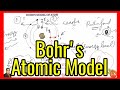 Bohr's Atomic model | Bohr's Model | mvr=nh/2π | ∆E=E2-E1 | Atomic Structure | Class 11 | Urdu Hindi
 0.1 mole of Na3PO4 completely dissociates in water to produce Na+1 (NMDCAT 2022 PREPARATION)
 Class 12 Ch#15 (Important Short Questions) Common chemical Industries in Pakistan Notes
 Structure of benzene after Kekule's Dream
 0.25 moles of phosphoric acid produces moles of H+ ions? (NMDCAT 2022 Preparation)
 What is dissolution #1styearchemistry2025 #gcse #igcse #ncrt
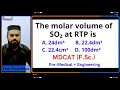 The molar volume of SO₂ at RTP is A. 24dm³, B. 22.4dm³, C. 22.4cm³, D. 100dm³ (MDCAT 2022)
 Equilibrium Constant Expressions for some important Chemical Reactions | Umair Khan Academy |
 Dobereiner Triad
 MDCAT MCQs preparation
 Class 11 chemistry Test 2 | Discussion (Free test Series by Sir Umair Khan)
 Chapter 3 (Lec28 -6) 1st Year Chemistry Intermolecular force Bond Energy Bond Length
 16g of unknown gas has volume of 11.2dm³ at STP. Unknown gas is? a. CO₂, b. CH4, c. HCI, d. 02 MDCAT
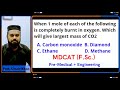 When 1 mole of the following is completely burnt in oxygen. Which will give largest mass of CO2
 Chapter 4 (Lec 40 -5) Molar mass and density of gases & molar concentration for class 11 new book
 Reaction Kinetics and chemical Equilibrium
 According to equation, how many grams of H2O is formed from mixture of 51g NH3 and 48g of O2
 Rutherford's Atomic model | Discovery of Nucleus | Class 11 | Atomic Structure | Urdu Hindi
 Liquid Solid Gas for 1st year and MDCAT preparation
 A photon of greater wavelength will have ? (NMDCAT 2022 chemistry preparation)
