- Популярные видео
- Авто
- Видео-блоги
- ДТП, аварии
- Для маленьких
- Еда, напитки
- Животные
- Закон и право
- Знаменитости
- Игры
- Искусство
- Комедии
- Красота, мода
- Кулинария, рецепты
- Люди
- Мото
- Музыка
- Мультфильмы
- Наука, технологии
- Новости
- Образование
- Политика
- Праздники
- Приколы
- Природа
- Происшествия
- Путешествия
- Развлечения
- Ржач
- Семья
- Сериалы
- Спорт
- Стиль жизни
- ТВ передачи
- Танцы
- Технологии
- Товары
- Ужасы
- Фильмы
- Шоу-бизнес
- Юмор
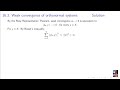
Functional Analysis_11. Weak Convergence_ 11.5 Weak-$*$ convergence
Consider $a=(a_k)_{k\in\mathbb{N}} \in \ell^\infty(\mathbb{R})$ and the sequence $\{x^{(n)}\}_{n\in\mathbb{N}} \subset \ell^\infty(\mathbb{R})$ defined by
$$x^{(n)} := (0, \dots, 0, a_{n+1}, a_{n+2}, \dots),$$
i.e., {\color{red} $x^{(n)}_k = a_{n+k}$ for all $k \in \mathbb{N}$}. Show that $x^{(n)} \xrightarrow{w^*} 0$. \vspace*{.4cm}
}
Clearly, $x^{(n)}_k = a_{n+k}$ for all $k \in \mathbb{N}$ gives
$$x^{(n)} = ( a_{n+1}, a_{n+2}, a_{n+3},\dots).$$
This must be a misprint: the displayed formula defines a cut-off tail, whereas the red “i.e.” defines a shifted tail; these are not the same sequence.
We will investigate both cases.
Видео Functional Analysis_11. Weak Convergence_ 11.5 Weak-$*$ convergence канала Dr. Szabó Tamás Zoltán
$$x^{(n)} := (0, \dots, 0, a_{n+1}, a_{n+2}, \dots),$$
i.e., {\color{red} $x^{(n)}_k = a_{n+k}$ for all $k \in \mathbb{N}$}. Show that $x^{(n)} \xrightarrow{w^*} 0$. \vspace*{.4cm}
}
Clearly, $x^{(n)}_k = a_{n+k}$ for all $k \in \mathbb{N}$ gives
$$x^{(n)} = ( a_{n+1}, a_{n+2}, a_{n+3},\dots).$$
This must be a misprint: the displayed formula defines a cut-off tail, whereas the red “i.e.” defines a shifted tail; these are not the same sequence.
We will investigate both cases.
Видео Functional Analysis_11. Weak Convergence_ 11.5 Weak-$*$ convergence канала Dr. Szabó Tamás Zoltán
szbtmsz Szabó Tamás Kalkulus Matematika Differenciálegyenletk Sorok Laplace-transzformált Derivált Határérték Analízis Komplex függvények Függvénysorok Többváltozós függvények Dota2 WorldofWarcraft Felezési idő Keverési feladatok Alapismeretek Functional Analysis Banach Spaces L^p spaces Linear Operators Functionals
Комментарии отсутствуют
Информация о видео
27 марта 2026 г. 13:00:18
00:08:01
Другие видео канала