
- Популярные видео
- Авто
- Видео-блоги
- ДТП, аварии
- Для маленьких
- Еда, напитки
- Животные
- Закон и право
- Знаменитости
- Игры
- Искусство
- Комедии
- Красота, мода
- Кулинария, рецепты
- Люди
- Мото
- Музыка
- Мультфильмы
- Наука, технологии
- Новости
- Образование
- Политика
- Праздники
- Приколы
- Природа
- Происшествия
- Путешествия
- Развлечения
- Ржач
- Семья
- Сериалы
- Спорт
- Стиль жизни
- ТВ передачи
- Танцы
- Технологии
- Товары
- Ужасы
- Фильмы
- Шоу-бизнес
- Юмор
This Number Is Randomn't
In 1933, a 20-year-old Cambridge undergraduate named David Champernowne wrote down this number:
0.12345678910111213141516…
You construct it by concatenating all positive integers after the decimal point. The digits are completely deterministic — given any position n, you can compute the n-th digit in seconds. Zero randomness anywhere in the construction.
And yet, Champernowne proved this number is "normal" in base 10. Every digit appears with frequency 1/10. Every two-digit string appears with frequency 1/100. Every length-k string appears with the right frequency for a random sequence of digits. Statistical tests cannot distinguish Champernowne's digits from the output of a fair die.
Four years later, Kurt Mahler proved something stronger: the number is transcendental. It cannot be the root of any polynomial with integer coefficients. The proof uses Liouville's theorem on rational approximation — the digit structure provides rationals that approximate the number too well for it to be algebraic.
This video unpacks: what "normal" means (Borel 1909), why Champernowne is normal, why normal doesn't mean random, Mahler's transcendence proof, the rational approximation trick, and why the same recipe gives us the Copeland–Erdős constant (concatenating primes).
The deeper lesson: π, e, √2 — we don't know if any of them are normal. But by careful construction, we can write down a number that demonstrably is.
Chapters
00:00 The number
01:50 What's normal?
04:00 Champernowne is normal
06:00 Normal doesn't mean random
08:00 Mahler's transcendence proof
10:20 The approximation trick
12:00 Other constructed transcendentals
13:30 What Champernowne means
References
- Champernowne (1933), "The construction of decimals normal in the scale of ten"
- Mahler (1937), "Arithmetische Eigenschaften einer Klasse von Dezimalbrüchen"
- Copeland & Erdős (1946), "Note on normal numbers"
- Borel (1909), "Les probabilités dénombrables et leurs applications arithmétiques"
#math #numbertheory #transcendental #normalnumbers #manim
Видео This Number Is Randomn't канала Euclidia
0.12345678910111213141516…
You construct it by concatenating all positive integers after the decimal point. The digits are completely deterministic — given any position n, you can compute the n-th digit in seconds. Zero randomness anywhere in the construction.
And yet, Champernowne proved this number is "normal" in base 10. Every digit appears with frequency 1/10. Every two-digit string appears with frequency 1/100. Every length-k string appears with the right frequency for a random sequence of digits. Statistical tests cannot distinguish Champernowne's digits from the output of a fair die.
Four years later, Kurt Mahler proved something stronger: the number is transcendental. It cannot be the root of any polynomial with integer coefficients. The proof uses Liouville's theorem on rational approximation — the digit structure provides rationals that approximate the number too well for it to be algebraic.
This video unpacks: what "normal" means (Borel 1909), why Champernowne is normal, why normal doesn't mean random, Mahler's transcendence proof, the rational approximation trick, and why the same recipe gives us the Copeland–Erdős constant (concatenating primes).
The deeper lesson: π, e, √2 — we don't know if any of them are normal. But by careful construction, we can write down a number that demonstrably is.
Chapters
00:00 The number
01:50 What's normal?
04:00 Champernowne is normal
06:00 Normal doesn't mean random
08:00 Mahler's transcendence proof
10:20 The approximation trick
12:00 Other constructed transcendentals
13:30 What Champernowne means
References
- Champernowne (1933), "The construction of decimals normal in the scale of ten"
- Mahler (1937), "Arithmetische Eigenschaften einer Klasse von Dezimalbrüchen"
- Copeland & Erdős (1946), "Note on normal numbers"
- Borel (1909), "Les probabilités dénombrables et leurs applications arithmétiques"
#math #numbertheory #transcendental #normalnumbers #manim
Видео This Number Is Randomn't канала Euclidia
Комментарии отсутствуют
Информация о видео
14 мая 2026 г. 19:35:15
00:13:11
Другие видео канала
 How Accurate are Reimann Sums?
 There are More Spirals Than you Thought
 Six Lissajous figures traced in real time.
 Parametric Curves are Beautiful
 The Problem That Took 85 Years and One Genius
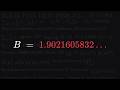 Twin Primes Add Up to 1.902..?
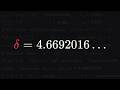 This Is What Chaos Equals | Feigenbaum's Constant
 Math's Most Embarrassing Open Problem
 The Most Powerful Pi Counter We Know
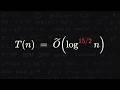 Two Undergrads Solved The Impossible Primality Problem
 The Most Ambitious Calculation in Number Theory
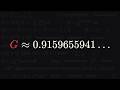 The Number Mathematicians Cannot Classify
 We Dont Know Why This Number Dosen't Exist
 The doodle that revealed a 200-year-old prime pattern
 Compute Any Digit Of Pi Without Computing The Others
 The Hidden Pattern in Every Irrational Number
 Why Do All Triangles Hide A Circle?
 There's a Number That Generates Primes — And No One Knows What It Is
 The Simple Math Problem That Took 244 Years to Crack
 There Are Bigger Infinities
