
- Популярные видео
- Авто
- Видео-блоги
- ДТП, аварии
- Для маленьких
- Еда, напитки
- Животные
- Закон и право
- Знаменитости
- Игры
- Искусство
- Комедии
- Красота, мода
- Кулинария, рецепты
- Люди
- Мото
- Музыка
- Мультфильмы
- Наука, технологии
- Новости
- Образование
- Политика
- Праздники
- Приколы
- Природа
- Происшествия
- Путешествия
- Развлечения
- Ржач
- Семья
- Сериалы
- Спорт
- Стиль жизни
- ТВ передачи
- Танцы
- Технологии
- Товары
- Ужасы
- Фильмы
- Шоу-бизнес
- Юмор
DAA 23 (Part 1) – P vs NP Intuition Using a 9x9 Sudoku Puzzle | CS F364
This lecture is DAA 23 (Part 1) in the Design and Analysis of Algorithms (DAA) course (CS F364). It gives a non-technical and intuitive introduction to the P versus NP question using a familiar example: a 9x9 Sudoku puzzle.
The lecture compares two very different tasks:
solving a Sudoku puzzle from scratch, and
verifying a completed Sudoku solution.
Using a concrete 9x9 Sudoku instance, the lecture demonstrates that solving the puzzle can be difficult, while checking a proposed solution is much easier. In this example, the puzzle could not be solved even after about 13 minutes of effort, whereas a completed solution could be verified in only about 5 minutes.
This intuitive contrast motivates one of the most important open questions in theoretical computer science:
If a solution can be verified quickly, can it also always be found quickly?
The lecture uses Sudoku to build intuition for the distinction between:
searching for a solution, and
verifying a given certificate.
This provides a natural entry point into the P versus NP question, without relying on heavy formalism. The goal is to help students develop strong conceptual understanding before moving to precise definitions and complexity-theoretic results in later parts.
9x9 Sudoku example taken from Sudoku for Kids by Maia Harvey.
📌 Topics Covered in This Lecture
9x9 Sudoku as an intuitive complexity example
Difference between solving and verifying
Why solving can be difficult
Why verification can be easy
Sudoku solution as a certificate
Search versus verification
Intuitive meaning of the P versus NP question
Non-technical motivation for complexity theory
Conceptual foundation for P and NP
🎯 Who Should Watch
Students studying Design and Analysis of Algorithms (DAA)
B.Tech / BE / M.Sc. / MCA / GATE aspirants
Learners beginning computational complexity theory
Anyone seeking an intuitive understanding of the P versus NP problem
🔗 Playlist
This video is part of the playlist:
Design and Analysis of Algorithms – Complete DAA Course
Видео DAA 23 (Part 1) – P vs NP Intuition Using a 9x9 Sudoku Puzzle | CS F364 канала Abhishek Mishra – Mathematics & TCS
The lecture compares two very different tasks:
solving a Sudoku puzzle from scratch, and
verifying a completed Sudoku solution.
Using a concrete 9x9 Sudoku instance, the lecture demonstrates that solving the puzzle can be difficult, while checking a proposed solution is much easier. In this example, the puzzle could not be solved even after about 13 minutes of effort, whereas a completed solution could be verified in only about 5 minutes.
This intuitive contrast motivates one of the most important open questions in theoretical computer science:
If a solution can be verified quickly, can it also always be found quickly?
The lecture uses Sudoku to build intuition for the distinction between:
searching for a solution, and
verifying a given certificate.
This provides a natural entry point into the P versus NP question, without relying on heavy formalism. The goal is to help students develop strong conceptual understanding before moving to precise definitions and complexity-theoretic results in later parts.
9x9 Sudoku example taken from Sudoku for Kids by Maia Harvey.
📌 Topics Covered in This Lecture
9x9 Sudoku as an intuitive complexity example
Difference between solving and verifying
Why solving can be difficult
Why verification can be easy
Sudoku solution as a certificate
Search versus verification
Intuitive meaning of the P versus NP question
Non-technical motivation for complexity theory
Conceptual foundation for P and NP
🎯 Who Should Watch
Students studying Design and Analysis of Algorithms (DAA)
B.Tech / BE / M.Sc. / MCA / GATE aspirants
Learners beginning computational complexity theory
Anyone seeking an intuitive understanding of the P versus NP problem
🔗 Playlist
This video is part of the playlist:
Design and Analysis of Algorithms – Complete DAA Course
Видео DAA 23 (Part 1) – P vs NP Intuition Using a 9x9 Sudoku Puzzle | CS F364 канала Abhishek Mishra – Mathematics & TCS
Комментарии отсутствуют
Информация о видео
20 марта 2026 г. 20:43:41
00:37:39
Другие видео канала
 DAA 22 (Part 2) – Non-Deterministic Turing Machines, NP & 2-Tape NTM for Repeated Words | CS F364
 DAA 10 (Part 1) – Optimal Caching Problem | Greedy Algorithm & Exchange Argument | CS F364
 DAA 13 (Part 2) – Matrix Chain Multiplication Algorithm, Complexity & Worked Example | CS F364
 DAA 18 (Part 2) – Ford–Fulkerson Worked Example | Maximum Flow and Minimum Cut | CS F364
 DAA 08 (Part 1) – Optimal Prefix Codes and Huffman’s Algorithm | Greedy Method | CS F364
 DAA 27 – Approximation Algorithms and 2-Approximation for Vertex Cover | CS F364
 DAA 19 (Part 1) – Bipartite Matching Using Maximum Flow | CS F364
 DAA 00 – Introduction to Design and Analysis of Algorithms | CS F364
 DAA 25 – 3SAT, 0/1 Integer Programming & Directed Hamiltonian Path | NP-Completeness | CS F364
 DAA 02 – Multiplication Algorithms | Divide and Conquer & Karatsuba | CS F364
 DAA 03 – Matrix Multiplication Algorithms | Divide and Conquer & Strassen | CS F364
 DAA 14 (Part 1) – Longest Common Subsequence (LCS): DP Formulation & Recurrence | CS F364
 DAA 36 – Divisibility, Division Algorithm and GCD as a Linear Combination | CS F364
 DAA 07 – Huffman Coding and Prefix Codes | Optimal Encoding Using Binary Trees | CS F364
 DAA 06 – Fractional Knapsack Problem | Greedy Algorithm & Proof | CS F364
 DAA 19 (Part 2) – Hall’s Theorem Proof & Perfect Matchings in Bipartite Graphs | CS F364
 DAA 21 (Part 2) – Multitape Turing Machine for Palindromes & Introduction to Class P | CS F364
 DAA 21 (Part 1) – Deterministic Algorithm Explained Using Snakes & Ladders | CS F364
 DAA 08 (Part 2) – Huffman’s Algorithm: Greedy Strategy, Optimality Proof & Time Complexity | CS F364
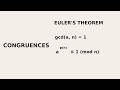 DAA 38 – Congruences, Residue Systems, Fermat’s Theorem and Euler’s Theorem | CS F364
