
- Популярные видео
- Авто
- Видео-блоги
- ДТП, аварии
- Для маленьких
- Еда, напитки
- Животные
- Закон и право
- Знаменитости
- Игры
- Искусство
- Комедии
- Красота, мода
- Кулинария, рецепты
- Люди
- Мото
- Музыка
- Мультфильмы
- Наука, технологии
- Новости
- Образование
- Политика
- Праздники
- Приколы
- Природа
- Происшествия
- Путешествия
- Развлечения
- Ржач
- Семья
- Сериалы
- Спорт
- Стиль жизни
- ТВ передачи
- Танцы
- Технологии
- Товары
- Ужасы
- Фильмы
- Шоу-бизнес
- Юмор
Lorenz Attractor — The Butterfly Effect Visualized (Python Simulation)
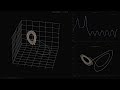
Two paths start just 0.00000001 apart. By the end, they are in completely different places. This is the butterfly effect -- made visible.
The Lorenz Attractor was discovered in 1963 by meteorologist Edward Lorenz while running a simplified weather simulation. He noticed that rounding a number from 0.506127 to 0.506 caused the entire forecast to diverge. That tiny difference changed everything. Chaos theory was born.
WHAT YOU ARE SEEING:
- Red path (A) and blue path (B) start offset by just 10^-8
- They follow the same butterfly-shaped attractor at first
- Watch the separation graph -- it grows exponentially until the paths are completely independent
- The 3D view slowly rotates so you can see the full attractor structure
THE LORENZ SYSTEM (3 equations):
dX/dt = sigma * (Y - X)
dY/dt = X * (rho - Z) - Y
dZ/dt = X*Y - beta*Z
Parameters used: sigma=10, rho=28, beta=8/3 (the classic chaotic regime)
WHY IT NEVER REPEATS:
The attractor has infinite complexity -- the path spirals around two lobes forever, switching between them unpredictably, but NEVER crossing itself and NEVER repeating. This is called a strange attractor.
WHAT STUDENTS LEARN:
- Nonlinear differential equations and dynamical systems
- Sensitive dependence on initial conditions (Lyapunov exponents)
- Why long-range weather forecasting is fundamentally impossible
- 3D visualization and RK4 numerical integration in Python
- The difference between chaos and randomness
Integrator: RK4 -- 4th order Runge-Kutta, dt=0.005
#ButterflyEffect #LorenzAttractor #ChaosTheory #Physics #Mathematics #Python #Simulation #STEM #Education #Calculus #DifferentialEquations
Видео Lorenz Attractor — The Butterfly Effect Visualized (Python Simulation) канала myClover
The Lorenz Attractor was discovered in 1963 by meteorologist Edward Lorenz while running a simplified weather simulation. He noticed that rounding a number from 0.506127 to 0.506 caused the entire forecast to diverge. That tiny difference changed everything. Chaos theory was born.
WHAT YOU ARE SEEING:
- Red path (A) and blue path (B) start offset by just 10^-8
- They follow the same butterfly-shaped attractor at first
- Watch the separation graph -- it grows exponentially until the paths are completely independent
- The 3D view slowly rotates so you can see the full attractor structure
THE LORENZ SYSTEM (3 equations):
dX/dt = sigma * (Y - X)
dY/dt = X * (rho - Z) - Y
dZ/dt = X*Y - beta*Z
Parameters used: sigma=10, rho=28, beta=8/3 (the classic chaotic regime)
WHY IT NEVER REPEATS:
The attractor has infinite complexity -- the path spirals around two lobes forever, switching between them unpredictably, but NEVER crossing itself and NEVER repeating. This is called a strange attractor.
WHAT STUDENTS LEARN:
- Nonlinear differential equations and dynamical systems
- Sensitive dependence on initial conditions (Lyapunov exponents)
- Why long-range weather forecasting is fundamentally impossible
- 3D visualization and RK4 numerical integration in Python
- The difference between chaos and randomness
Integrator: RK4 -- 4th order Runge-Kutta, dt=0.005
#ButterflyEffect #LorenzAttractor #ChaosTheory #Physics #Mathematics #Python #Simulation #STEM #Education #Calculus #DifferentialEquations
Видео Lorenz Attractor — The Butterfly Effect Visualized (Python Simulation) канала myClover
Комментарии отсутствуют
Информация о видео
31 марта 2026 г. 6:55:30
00:01:24
Другие видео канала
 Why a tornado spins faster as it narrows, it can't do anything else
 What's hiding inside this fractal?
 Double Slit Experiment — Quantum Wave Interference Visualized (Python Simulation)
 Any shape in existence can be drawn with spinning circles
 Lorenz Attractor — When Tiny Differences Change Everything (Python)
 What if lightning could grow in slow motion?
 900 Particles Build Alien Life.
 What if 3,000 particles collapsed under gravity?
 Pendulum Wave: Order Emerging from Chaos (15 Pendulums)
 Magnetic Pendulum — Chaos From 3 Magnets (Python Simulation)
 Five black holes, mutual gravity, total chaos
 What happens when two galaxies collide? 🌌
 What if 500 birds followed just 3 simple rules?
 This is what wind looks like behind an obstacle
 Math Hidden in Music — Lissajous Figures #Shorts
 A leopard's spots come from two chemicals reacting
 SIR Epidemic Model — How Disease Spreads (and How Vaccines Stop It)
 What's hiding at the edge of the Mandelbrot set?
 50 Pendulums. Tiny Difference. Total Chaos.
 Electrons can pass through walls they don't have enough energy to climb
 Spin any object around its middle axis and it flips. Every time.
