
- Популярные видео
- Авто
- Видео-блоги
- ДТП, аварии
- Для маленьких
- Еда, напитки
- Животные
- Закон и право
- Знаменитости
- Игры
- Искусство
- Комедии
- Красота, мода
- Кулинария, рецепты
- Люди
- Мото
- Музыка
- Мультфильмы
- Наука, технологии
- Новости
- Образование
- Политика
- Праздники
- Приколы
- Природа
- Происшествия
- Путешествия
- Развлечения
- Ржач
- Семья
- Сериалы
- Спорт
- Стиль жизни
- ТВ передачи
- Танцы
- Технологии
- Товары
- Ужасы
- Фильмы
- Шоу-бизнес
- Юмор
Structured PLC Programming: UDTs as Classes in Studio 5000
User-Defined Data Types (UDTs) are a fundamental programming construct in Rockwell Studio 5000 for Allen-Bradley Distributed Control Systems (DCS). UDTs enable the logical grouping of related data into standardized structures, supporting modular control strategies and consistent data modeling across the system.
The proper design and application of UDTs improves program readability, reduces configuration errors, simplifies maintenance and troubleshooting, and enhances system scalability. This section defines recommended best practices for creating, naming, and implementing UDTs to ensure long-term reliability, standardization, and maintainability of the DCS application.
Purpose
User-Defined Data Types (UDTs) are a fundamental programming construct in Rockwell Studio 5000 for Allen-Bradley Distributed Control Systems (DCS). UDTs provide standardized, structured data models that support modular control strategies, consistent naming conventions, and scalable system architectures.
Proper implementation of UDTs improves program readability, minimizes configuration errors, simplifies troubleshooting, and ensures long-term maintainability of the DCS application.
Mandatory Requirements
The following rules shall be applied when using UDTs in Studio 5000 DCS projects:
Standardization
All commonly reused equipment and instrument data shall be implemented using approved UDTs.
UDTs shall be defined in a centralized library and reused consistently across the project.
Naming Conventions
UDT names shall follow the project naming standard (e.g., UDT_Motor, UDT_Valve, UDT_AI).
Member names shall be clear, descriptive, and consistent across all UDTs.
Data Integrity
UDT structures shall not be modified after deployment without impact analysis and formal approval.
Changes to UDT definitions shall be version-controlled.
Documentation
Each UDT shall include a description defining its purpose and intended usage.
All members within the UDT shall be commented.
Recommended Best Practices
The following practices should be applied to improve system quality and maintainability:
Group related parameters logically (e.g., Commands, Status, Alarms, Configuration).
Avoid excessive nesting of UDTs to maintain performance and readability.
Separate configuration data from runtime status data where practical.
Align UDT design with ISA-88 / ISA-95 concepts for equipment and control modules.
Design UDTs to support HMI, alarm, and historian integration without additional mapping.
Typical UDT Categories
Standard UDTs typically include, but are not limited to:
Equipment UDTs
Motor
Valve
Pump
Drive (VFD)
Instrumentation UDTs
Analog Input (AI)
Analog Output (AO)
Digital Input (DI)
Digital Output (DO)
Control UDTs
PID
Interlocks
Sequences
Alarm & Diagnostic UDTs
Alarm status
Fault codes
Maintenance indicators
Benefits
Implementing UDTs in accordance with this standard ensures:
Consistent data modeling across the DCS
Reduced engineering and commissioning effort
Easier troubleshooting and future system expansion
Improved alignment between PLC logic, HMI, and plant standards
🔹 Subscribe for more PLC & Automation tutorials
🔹 Like 👍 | Comment 💬 | Share 🔁
🔹 Follow for more industrial automation learning content
#RockwellAutomation #Studio5000 #PLCProgramming #AllenBradley #PLCTutorial
#IndustrialAutomation #ControlLogix #CompactLogix #LadderLogic #AutomationEngineer
#UDT #UserDefinedDataType #PLCLearning #AutomationTraining #PLCProjects
Видео Structured PLC Programming: UDTs as Classes in Studio 5000 канала AGEIN PRIVATE LIMITED
The proper design and application of UDTs improves program readability, reduces configuration errors, simplifies maintenance and troubleshooting, and enhances system scalability. This section defines recommended best practices for creating, naming, and implementing UDTs to ensure long-term reliability, standardization, and maintainability of the DCS application.
Purpose
User-Defined Data Types (UDTs) are a fundamental programming construct in Rockwell Studio 5000 for Allen-Bradley Distributed Control Systems (DCS). UDTs provide standardized, structured data models that support modular control strategies, consistent naming conventions, and scalable system architectures.
Proper implementation of UDTs improves program readability, minimizes configuration errors, simplifies troubleshooting, and ensures long-term maintainability of the DCS application.
Mandatory Requirements
The following rules shall be applied when using UDTs in Studio 5000 DCS projects:
Standardization
All commonly reused equipment and instrument data shall be implemented using approved UDTs.
UDTs shall be defined in a centralized library and reused consistently across the project.
Naming Conventions
UDT names shall follow the project naming standard (e.g., UDT_Motor, UDT_Valve, UDT_AI).
Member names shall be clear, descriptive, and consistent across all UDTs.
Data Integrity
UDT structures shall not be modified after deployment without impact analysis and formal approval.
Changes to UDT definitions shall be version-controlled.
Documentation
Each UDT shall include a description defining its purpose and intended usage.
All members within the UDT shall be commented.
Recommended Best Practices
The following practices should be applied to improve system quality and maintainability:
Group related parameters logically (e.g., Commands, Status, Alarms, Configuration).
Avoid excessive nesting of UDTs to maintain performance and readability.
Separate configuration data from runtime status data where practical.
Align UDT design with ISA-88 / ISA-95 concepts for equipment and control modules.
Design UDTs to support HMI, alarm, and historian integration without additional mapping.
Typical UDT Categories
Standard UDTs typically include, but are not limited to:
Equipment UDTs
Motor
Valve
Pump
Drive (VFD)
Instrumentation UDTs
Analog Input (AI)
Analog Output (AO)
Digital Input (DI)
Digital Output (DO)
Control UDTs
PID
Interlocks
Sequences
Alarm & Diagnostic UDTs
Alarm status
Fault codes
Maintenance indicators
Benefits
Implementing UDTs in accordance with this standard ensures:
Consistent data modeling across the DCS
Reduced engineering and commissioning effort
Easier troubleshooting and future system expansion
Improved alignment between PLC logic, HMI, and plant standards
🔹 Subscribe for more PLC & Automation tutorials
🔹 Like 👍 | Comment 💬 | Share 🔁
🔹 Follow for more industrial automation learning content
#RockwellAutomation #Studio5000 #PLCProgramming #AllenBradley #PLCTutorial
#IndustrialAutomation #ControlLogix #CompactLogix #LadderLogic #AutomationEngineer
#UDT #UserDefinedDataType #PLCLearning #AutomationTraining #PLCProjects
Видео Structured PLC Programming: UDTs as Classes in Studio 5000 канала AGEIN PRIVATE LIMITED
User Defined Data Types in Studio 5000 Rockwell Studio 5000 UDT tutorial UDT explained in Studio 5000 How to create UDT in Studio 5000 Rockwell Automation PLC training Studio 5000 tutorial for beginners Allen Bradley UDT programming PLC programming Rockwell Automation ControlLogix UDT example CompactLogix UDT structure Studio 5000 data types explained UDT vs Tags in PLC programming Rockwell PLC data organization Industrial automation course
Комментарии отсутствуют
Информация о видео
10 января 2026 г. 9:39:51
00:17:46
Другие видео канала
 Allen Bradley Micro800 PLC Programming | Chapter-2 Part-1 | NC Contact & Difference NO & NC | CCW
 Holding & Breaking Concept in PLC using Pulse Timer | Schneider TM200 PLC | Hindi
 PLC Programming Comparison Instructions LES, GRT, LEQ & GEQ | Analog vs Digital Signals | Hindi
 Siemens PLC - TIA Portal Math Functions ADD & SUB | Create Analog level using digital level switches
 How to use LIMIT TEST (LIM) in PLC Programming? | "Equal to (EQU)" , "not equal to (NEQ)" | in Hindi
 Math Functions: INC (Increment) & DEC (Decrement) using Positive & Negative Edge | TIA Portal -Hindi
 How to Create & Use UDTs in Studio 5000 | Allen-Bradley PLC Programming Tips
 Count Up (CTU) Counter | What is up counter in PLC? | Mcro800 | CCW | PLC Training Tutorial#9 Hindi
 How to configure trends, Grapha or charts in Allen Bradley Panelview 800 HMI? | HMI#3 | Hindi
 Math Functions: MIN (Get minimum) and MAX (Get maximum) & LIMIT (Set limit value)| TIA Portal -Hindi
 Delta PLC Programing 5 basic Instructions NO, NC, direct Coil, Set Coil and Reset Coil | DVP-14SS2
 What is PID and how does it work? | PID Function Block in Machine Expert Basic | Schneider M200 PLC.
 Allen Bradley Micro800 PLC | Chapter-4 Part-1 | Digital & Analog Variables with Data Types | CCW
 Trends , Charts or graphs in WinCC Professional SCADA system? | Real Time Trends | in Hindi
 Function Generator (FGEN) - input Table based a piece-wise linear Output Generator | STUDIO5000 FBD
 Input Selection SEL & ESEL Function Block - FBD Programming in Studio5000/RSLogix5000 | Part6-Hindi
 FTV Reporting | How to log data records in Microsoft Access through ODBC connection?
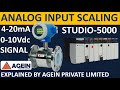 Analog Input Scaling – FBD in Studio5000 | LIVE Allen-Bradley PLC/DCS Tutorial
 What is Holding & Breaking Concept in PLC Programming ? | SET/RESET or LATCH/UNLATCH Coils | Hindi
 On Delay Timer (TON), Retentive On Delay Timer (RTO) & Off Delay Timer (TOF) in Micrologix PLC-Hindi
