
- Популярные видео
- Авто
- Видео-блоги
- ДТП, аварии
- Для маленьких
- Еда, напитки
- Животные
- Закон и право
- Знаменитости
- Игры
- Искусство
- Комедии
- Красота, мода
- Кулинария, рецепты
- Люди
- Мото
- Музыка
- Мультфильмы
- Наука, технологии
- Новости
- Образование
- Политика
- Праздники
- Приколы
- Природа
- Происшествия
- Путешествия
- Развлечения
- Ржач
- Семья
- Сериалы
- Спорт
- Стиль жизни
- ТВ передачи
- Танцы
- Технологии
- Товары
- Ужасы
- Фильмы
- Шоу-бизнес
- Юмор
STRUCTURE OF DNA || POLYNUCLEOTIDE || BASE PARING
Polynucleotides are the building blocks of nucleic acids, such as DNA and RNA. They are made up of repeating units called nucleotides, which are composed of three parts: a nitrogenous base, a five-carbon sugar, and a phosphate group.
There are four different types of nitrogenous bases found in nucleotides: adenine (A), guanine (G), cytosine (C), and thymine (T) in DNA or uracil (U) in RNA. These bases pair with one another in a specific way to form the double helix structure of DNA. Adenine always pairs with thymine (or uracil in RNA), while guanine always pairs with cytosine.
The sugar component of a nucleotide is either deoxyribose or ribose, depending on whether it is found in DNA or RNA, respectively. Deoxyribose is a five-carbon sugar with one less oxygen atom than ribose, making it more stable and less prone to damage. Ribose, on the other hand, has an additional oxygen atom, which makes it more reactive and more prone to damage.
The phosphate group is attached to the 5' carbon of the sugar molecule in the nucleotide. These phosphate groups form phosphodiester bonds between adjacent nucleotides, creating a linear chain of nucleotides known as a polynucleotide.
The sequence of nitrogenous bases in a polynucleotide chain determines the genetic information encoded in the nucleic acid. DNA encodes the genetic instructions for the development, growth, and function of all living organisms. RNA, on the other hand, plays a crucial role in the process of protein synthesis, where it acts as a messenger between DNA and the ribosomes, the cellular machinery that synthesizes proteins.
In DNA, the double helix structure allows for the storage and transmission of genetic information. The two polynucleotide chains are held together by hydrogen bonds between the complementary nitrogenous bases, forming base pairs. The base pairs stack on top of one another, creating a stable structure that is resistant to damage and mutation.
In RNA, the single-stranded polynucleotide chain can fold back on itself, forming complex three-dimensional structures. These structures play a crucial role in the regulation of gene expression and other cellular processes.
Polynucleotides are also involved in a variety of biochemical reactions within cells. For example, the hydrolysis of the phosphodiester bonds in a polynucleotide chain releases energy that can be used by the cell for various processes. In addition, nucleotides are involved in the synthesis of many important biomolecules, such as coenzymes and signaling molecules.
In conclusion, polynucleotides are essential building blocks of nucleic acids and play a crucial role in storing, transmitting, and expressing genetic information. Understanding the structure and function of polynucleotides is crucial for understanding the mechanisms of DNA replication, transcription, and translation, as well as many other important cellular processes
Видео STRUCTURE OF DNA || POLYNUCLEOTIDE || BASE PARING канала neetrankers
There are four different types of nitrogenous bases found in nucleotides: adenine (A), guanine (G), cytosine (C), and thymine (T) in DNA or uracil (U) in RNA. These bases pair with one another in a specific way to form the double helix structure of DNA. Adenine always pairs with thymine (or uracil in RNA), while guanine always pairs with cytosine.
The sugar component of a nucleotide is either deoxyribose or ribose, depending on whether it is found in DNA or RNA, respectively. Deoxyribose is a five-carbon sugar with one less oxygen atom than ribose, making it more stable and less prone to damage. Ribose, on the other hand, has an additional oxygen atom, which makes it more reactive and more prone to damage.
The phosphate group is attached to the 5' carbon of the sugar molecule in the nucleotide. These phosphate groups form phosphodiester bonds between adjacent nucleotides, creating a linear chain of nucleotides known as a polynucleotide.
The sequence of nitrogenous bases in a polynucleotide chain determines the genetic information encoded in the nucleic acid. DNA encodes the genetic instructions for the development, growth, and function of all living organisms. RNA, on the other hand, plays a crucial role in the process of protein synthesis, where it acts as a messenger between DNA and the ribosomes, the cellular machinery that synthesizes proteins.
In DNA, the double helix structure allows for the storage and transmission of genetic information. The two polynucleotide chains are held together by hydrogen bonds between the complementary nitrogenous bases, forming base pairs. The base pairs stack on top of one another, creating a stable structure that is resistant to damage and mutation.
In RNA, the single-stranded polynucleotide chain can fold back on itself, forming complex three-dimensional structures. These structures play a crucial role in the regulation of gene expression and other cellular processes.
Polynucleotides are also involved in a variety of biochemical reactions within cells. For example, the hydrolysis of the phosphodiester bonds in a polynucleotide chain releases energy that can be used by the cell for various processes. In addition, nucleotides are involved in the synthesis of many important biomolecules, such as coenzymes and signaling molecules.
In conclusion, polynucleotides are essential building blocks of nucleic acids and play a crucial role in storing, transmitting, and expressing genetic information. Understanding the structure and function of polynucleotides is crucial for understanding the mechanisms of DNA replication, transcription, and translation, as well as many other important cellular processes
Видео STRUCTURE OF DNA || POLYNUCLEOTIDE || BASE PARING канала neetrankers
Комментарии отсутствуют
Информация о видео
2 февраля 2023 г. 9:30:08
00:04:03
Другие видео канала
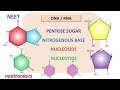 COMPONENT OF POLYNUCLEOTIDE || NUCLEOTIDES || NUCLEOSIDES || PENTOSE SUGAR || RIBOSE || DEOXYRIBOSE
 Male reproductive system with Animation #neetmotivation #NEET_RANKERS #neet2023 #neetbiology #neet
 Str. of Flower
 DNA REPLICATION with animation || COMPLETE DNA REPLICATION FOR NEET EXAM
 CELL CYCLE with Animation || Cell cycle for NEET exam || mitosis class 11 NCERT ||
 COMPONENTS OF BLOOD || NEET BIOLOGY SHORTS
 Megasporogenesis and formation of Embryo sac || Class 12 NCERT || NEET 2025 || Structure of Ovule
 ABO Blood grouping #neetbiology #neet2023 #neetmotivation #neet #ncert_biology #neetpreparation
 Structure of Kidney #neet_rankers #neetbiology #neet2023 #neetmotivation #neetpreparation #neet
 Meiosis with Animation | Reduction division NCERT | NEET BIOLOGY with Animation #neetrankers #neet
 LUNGS CAPACITY AND VOLUMES || RESPIRATORY SYSTEM NCERT || Trick to learn Lung capacity
 Microsporogenesis and formation of Pollen grain || Class 12 NCERT || Str. of Anther
 COMPLETE 206 BONES OF HUMAN BODY WITH FULL DETAILS II पूरे 206 हड्डियां एक विडियो में
 Structure of Nephron #neet_rankers #neetbiology #neetmotivation #ncert_biology #neetpreparation
 हाथ के पंजे में कुल कितनी हड्डियां होती हैं // कलाई में कितनी हड्डी होती है // Wrist Bone Number
 Type of Nephron Cortical and Juxtamedullary nephron #neet_rankers #neetbiology #neetpreparation#neet
 Megasporogenesis class 12 with Animation #neet_rankers #neetbiology #ncert_biology #neetmotivation
 Structure of LIVER and Hepatic lobules #neet rankers #neetbiology #neetmotivation #neet2023 #NEET
 Structure of Ovule (Megasporangium) #neet rankers #neetaspirant #neet #neetrankers #neet2023
 Microsporogenesis and formation of Pollen grain #neet_rankers #neetmotivation #neetpreparation #neet
